Showing posts with label TEPCO. Show all posts
Showing posts with label TEPCO. Show all posts
19 September 2011


06 September 2011
Fukushima Japan TOTALLY OUT of CONTROL
Fukushima Japan TOTALLY OUT of CONTROL Mirrored from
ushima Japan TOTALLY OUT of CONTROL Mirrored from BUG BelieversUnderGround with thanks
23 August 2011
From Hiroshima to Fukushima: Japan Set to Declare Wide Area Uninhabitable Due to Radiation
From Hiroshima to Fukushima: Japan Set to Declare Wide Area Uninhabitable Due to Radiation
Aug. 22, 2011
By Greg Mitchell
The worst nuclear disaster to strike Japan since a single bomb fell over Nagasaki in 1945 occurred in the spring of 2011 at the Fukushima nuclear power plant following the epic tsunami. On August 22, The New York Times reports (in submerged fashion, headlining Gaddafi’s imminent fall in Libya) the disturbing news that a wide area around the Fukushima plant "could soon be declared uninhabitable, perhaps for decades, after a government survey found radioactive contamination that far exceeded safe levels.”
According to The Times, "The formal announcement, expected from the government in coming days, would be the first official recognition that the March accident could force the long-term depopulation of communities near the plant, an eventuality that scientists and some officials have been warning about for months." Just two weeks ago, it was reported that radiation readings at the site had reached their highest points to date.
As Winifred Bird and Elizabeth Grossman report, moreover, radiation risks have been compounded by severe chemical contamination throughout the Fukushima area and its peripheries as a result of earthquake tsunami destruction of petro-and agrochemical plants, iron foundries, steel works, automotive, electronics, plastics and pharmaceutical plants among others. Toxic Watch Network posted a map of 130 such facilities throughout the Northeast Region (http://japanfocus.org/-Winifred-Bird/3588).
Above all, the wide release of radiation, and fear of same, has forced the Japanese and others all over the world to reflect on what happened to the country in 1945, and the continuing (but usually submerged) threat of nuclear weapons and energy today.
In its main story marking the sixty-sixth anniversary of the atomic bombings, the New York Times highlighted the new activism of survivors of the bombing (the hibakusha): campaigning against nuclear power, which has provided most of their country’s energy needs. No one in the world can better relate to the fears of a wide populace terrified that they (and perhaps the unborn) may be tainted forever by exposure to radiation.
As Kodama Tatsuhiko, head of the Tokyo University Radioisotope Center has pointed out, the Japanese government has both concealed and distorted the true dimensions of radioactivity released following the meltdown of the Fukushima Daiichi nuclear power reactors. Kodama observes that, “according to what we know so far, when we compare the amount of radiation that remained after the a-bomb and that of radiation from the nuclear plant, that of the former goes down to one-thousandth after one year whereas radioactive contaminants of the latter are reduced to only one-tenth.” (http://japanfocus.org/-Kodama-Tatsuhiko/3587) Zeroing in on the critical dangers to pregnant women and infants, he shows the extremely high risk of cancer in areas of radiation concentration in the form of Iodine and Cesium isotopes. Above all, Kodama shows that, given the vagaries of wind, rain, and terrain, the danger zone is by no means limited to the proposed evacuation zone.
My colleague Robert Jay Lifton in an op-ed for the New York Times titled “From Hiroshima to Fukushima,” pointedly asked “how it is possible that Japan, after its experience with the atomic bombings, could allow itself to draw so heavily on the same nuclear technology for the manufacture of about a third of its energy.” His answer was that there was “ . . . a pattern of denial, cover-up and cozy bureaucratic collusion between industry and government, the last especially notorious in Japan but by no means limited to that country.” [Yuki Tanaka explains why, before 3.11, with very few exceptions, there was little Hibakusha resistance to nuke power.]
The Mainichi Shimbun sought out Taniguchi Sumiteru, now 82, and currently director of the Nagasaki A-Bomb Survivors Council, for comment. It noted that while he normally talks quietly and haltingly, “when the conversation turns to the ongoing crisis at the Fukushima No. 1 Nuclear Power Plant it is as if the floodgates open, and his tone suddenly turns harsh.” Taniguchi said: “Nuclear power and mankind cannot coexist. We survivors of the atomic bomb have said this all along. And yet, the use of nuclear power was camouflaged as ‘peaceful’ and continued to progress. You never know when there’s going to be a natural disaster. You can never say that there will never be a nuclear accident.”
As it happens, I have interviewed Taniguchi three times, in the United States and in Japan. He is perhaps the iconic symbol of the hibakusha today, thanks to footage of him taken after the bombing, showing him, months after the attack, still on a floor, spread-eagled, his entire back an open wound, flaming red. It was part of footage shot by a US film crew, and suppressed for decades, as I probe in my new book Atomic Cover-Up. (You can see some of the Taniguchi footage here.)
In April, 2011, five survivors’ organizations including Taniguchi’s Nagasaki group submitted a statement to the Japanese government declaring the collapse of the “safety myth” around nuclear power and demanding a change in the government’s energy policy to prevent creating any more hibakusha. And Hidankyo, the nationwide organization of hibakusha, where Taniguchi still serves on the board, “has sent a statement to the government,” Mainichi Shimbun reported, “demanding that it distribute health record booklets—similar to the ones that are distributed to atomic bomb victims and can be used as proof of radiation exposure—to nuclear power plant workers and residents living close to them, and also provide periodic health examinations to those populations.”
Taniguchi pointed out that numerous A-bomb survivors over the decades had sought help from the government after falling ill or suffering cancer and other diseases, allegedly from radiation exposure, but had been “abandoned.” The Mainichi article closed with this question: Will the people who are suffering from invisible dangers in Fukushima be subjected to the same treatment?
Of course, the Fukushima disaster forced me to relive my own experiences in visiting the atomic cities, and research into the significance of their bombing and the American “cover-up” since. I was hardly alone. Writing in a New York Times op-ed after Fukushima, Nassrine Azimi, a senior adviser at a United Nations Institute, observed: “When it comes to nuclear issues—from atomic weapons to nuclear power—no two nations could be more irredeemably intertwined. After the atomic destruction of Hiroshima and Nagasaki, despite dissenting voices of some of its own citizens, America drew mostly wrong conclusions as it plunged into nuclear expansion.” She cited the book Lifton and I wrote several years ago, Hiroshima in America, for its painstaking account of “the relentless public relations campaign—unleashed by the Truman administration almost within hours of the Hiroshima bombing—that led to the Faustian bargain that blinded the Americans (and later the Japanese) to the insidious, long-term damage of radiation. Prominent journalists and media outlets of the time embraced, with enthusiasm, the ‘Dawn of the Atomic Age’ and America fell, in the authors’ words, into the ‘nuclear entrapment’ that is with us to this day.”
The 3.11 earthquake tsunami and nuclear meltdown have opened the way for hibakusha and the Japanese people to revisit the decision to predicate their energy future on nuclear power. While it would be premature to judge the outcome, critics of the exorbitant human, natural and financial costs of nuclear power in earthquake prone Japan, have begun to make their voices heard. Official recognition of the contamination of Fukushima will strengthen their convictions.
According to The Times, "The formal announcement, expected from the government in coming days, would be the first official recognition that the March accident could force the long-term depopulation of communities near the plant, an eventuality that scientists and some officials have been warning about for months." Just two weeks ago, it was reported that radiation readings at the site had reached their highest points to date.
As Winifred Bird and Elizabeth Grossman report, moreover, radiation risks have been compounded by severe chemical contamination throughout the Fukushima area and its peripheries as a result of earthquake tsunami destruction of petro-and agrochemical plants, iron foundries, steel works, automotive, electronics, plastics and pharmaceutical plants among others. Toxic Watch Network posted a map of 130 such facilities throughout the Northeast Region (http://japanfocus.org/-Winifred-Bird/3588).
Above all, the wide release of radiation, and fear of same, has forced the Japanese and others all over the world to reflect on what happened to the country in 1945, and the continuing (but usually submerged) threat of nuclear weapons and energy today.
In its main story marking the sixty-sixth anniversary of the atomic bombings, the New York Times highlighted the new activism of survivors of the bombing (the hibakusha): campaigning against nuclear power, which has provided most of their country’s energy needs. No one in the world can better relate to the fears of a wide populace terrified that they (and perhaps the unborn) may be tainted forever by exposure to radiation.
As Kodama Tatsuhiko, head of the Tokyo University Radioisotope Center has pointed out, the Japanese government has both concealed and distorted the true dimensions of radioactivity released following the meltdown of the Fukushima Daiichi nuclear power reactors. Kodama observes that, “according to what we know so far, when we compare the amount of radiation that remained after the a-bomb and that of radiation from the nuclear plant, that of the former goes down to one-thousandth after one year whereas radioactive contaminants of the latter are reduced to only one-tenth.” (http://japanfocus.org/-Kodama-Tatsuhiko/3587) Zeroing in on the critical dangers to pregnant women and infants, he shows the extremely high risk of cancer in areas of radiation concentration in the form of Iodine and Cesium isotopes. Above all, Kodama shows that, given the vagaries of wind, rain, and terrain, the danger zone is by no means limited to the proposed evacuation zone.
My colleague Robert Jay Lifton in an op-ed for the New York Times titled “From Hiroshima to Fukushima,” pointedly asked “how it is possible that Japan, after its experience with the atomic bombings, could allow itself to draw so heavily on the same nuclear technology for the manufacture of about a third of its energy.” His answer was that there was “ . . . a pattern of denial, cover-up and cozy bureaucratic collusion between industry and government, the last especially notorious in Japan but by no means limited to that country.” [Yuki Tanaka explains why, before 3.11, with very few exceptions, there was little Hibakusha resistance to nuke power.]
The Mainichi Shimbun sought out Taniguchi Sumiteru, now 82, and currently director of the Nagasaki A-Bomb Survivors Council, for comment. It noted that while he normally talks quietly and haltingly, “when the conversation turns to the ongoing crisis at the Fukushima No. 1 Nuclear Power Plant it is as if the floodgates open, and his tone suddenly turns harsh.” Taniguchi said: “Nuclear power and mankind cannot coexist. We survivors of the atomic bomb have said this all along. And yet, the use of nuclear power was camouflaged as ‘peaceful’ and continued to progress. You never know when there’s going to be a natural disaster. You can never say that there will never be a nuclear accident.”
As it happens, I have interviewed Taniguchi three times, in the United States and in Japan. He is perhaps the iconic symbol of the hibakusha today, thanks to footage of him taken after the bombing, showing him, months after the attack, still on a floor, spread-eagled, his entire back an open wound, flaming red. It was part of footage shot by a US film crew, and suppressed for decades, as I probe in my new book Atomic Cover-Up. (You can see some of the Taniguchi footage here.)
In April, 2011, five survivors’ organizations including Taniguchi’s Nagasaki group submitted a statement to the Japanese government declaring the collapse of the “safety myth” around nuclear power and demanding a change in the government’s energy policy to prevent creating any more hibakusha. And Hidankyo, the nationwide organization of hibakusha, where Taniguchi still serves on the board, “has sent a statement to the government,” Mainichi Shimbun reported, “demanding that it distribute health record booklets—similar to the ones that are distributed to atomic bomb victims and can be used as proof of radiation exposure—to nuclear power plant workers and residents living close to them, and also provide periodic health examinations to those populations.”
Taniguchi pointed out that numerous A-bomb survivors over the decades had sought help from the government after falling ill or suffering cancer and other diseases, allegedly from radiation exposure, but had been “abandoned.” The Mainichi article closed with this question: Will the people who are suffering from invisible dangers in Fukushima be subjected to the same treatment?
Of course, the Fukushima disaster forced me to relive my own experiences in visiting the atomic cities, and research into the significance of their bombing and the American “cover-up” since. I was hardly alone. Writing in a New York Times op-ed after Fukushima, Nassrine Azimi, a senior adviser at a United Nations Institute, observed: “When it comes to nuclear issues—from atomic weapons to nuclear power—no two nations could be more irredeemably intertwined. After the atomic destruction of Hiroshima and Nagasaki, despite dissenting voices of some of its own citizens, America drew mostly wrong conclusions as it plunged into nuclear expansion.” She cited the book Lifton and I wrote several years ago, Hiroshima in America, for its painstaking account of “the relentless public relations campaign—unleashed by the Truman administration almost within hours of the Hiroshima bombing—that led to the Faustian bargain that blinded the Americans (and later the Japanese) to the insidious, long-term damage of radiation. Prominent journalists and media outlets of the time embraced, with enthusiasm, the ‘Dawn of the Atomic Age’ and America fell, in the authors’ words, into the ‘nuclear entrapment’ that is with us to this day.”
The 3.11 earthquake tsunami and nuclear meltdown have opened the way for hibakusha and the Japanese people to revisit the decision to predicate their energy future on nuclear power. While it would be premature to judge the outcome, critics of the exorbitant human, natural and financial costs of nuclear power in earthquake prone Japan, have begun to make their voices heard. Official recognition of the contamination of Fukushima will strengthen their convictions.
This is a slightly revised and expanded version of an article by Greg Mitchell at The Nation, August 22, 2011. Greg Mitchell’s new book is “Atomic Cover-Up: Two U.S. Soldiers, Hiroshima & Nagasaki, and The Greatest Movie Never Made.” Email: epic1934@aol.com.
21 August 2011
Fukushima: Pacific Ocean Radiation Over 3,000 Times Normal — Doctors Refusing To Treat Radiation Poisoning
Posted by Alexander Higgins - August 15, 2011 at 7:37 pm - Permalink - Source via Alexander Higgins Blog
The Canadian reports:


Fukushima nuclear radiation is being detected in the Pacific Ocean at levels 3,000 times normals as doctors refuse to treat people for radiation poisoning.
The Canadian reports:
Japan’s nuclear accident has caused radiation levels in the Pacfic Ocean to rise over 3,000 times normal. Say what?
Top scientists in the field of Marine Chemistry, have done the testing and research and the result is not good. Fukushima’s poison radiated water spewn into the pacific ocean will cause malformations in ocean life as well as the resulting food chain [ that's us], from platunium, I131 and ZM133 in the ocean.
It is very important that you see the ending result of this testing. You and I will be affected by the radiation as well as our farm animals, food supply and air. Yes our air.
Where do you think the condensation from the ocean goes? Remember the ol’ saying by Newton.. what goes up, must come down.
Dr. Chris Busby in the video above also indicates that doctors are refusing to treat patients for radiation sicknesses. That is apparently because these doctors are concerned that treating them would make that vulnerable to radiation sicknesses.
[...]
Source: The Canadian
Related Posts
Experts warn off-scale levels of radiation, which are at their highest levels since the disaster began almost 5 months ago, infers hundreds millions dying from the nuclear fallout. Deborah Dupre, Human ...
READ MORE 52,547 Bq/Kg of Cesium radiation measured in soil samples collected just outside of Tokyo over 135 miles south of the Fukushima nuclear power plant. A reader from Japan has sent me ...
READ MORE Grave news as Japan nuclear radiation levels in Seattle hits 50% of levels detected in Tokyo Knucklz writes: See Video Here (couldn't get it to embed and it's not uploaded to Youtube.com yet) ...
READ MORE Radiation News 4-24-2011 via Dprogram.net with yet another Geiger counter reading from a citizen coming out of the rain showing high levels of Japan nuclear radiation in the rain. Via DProgram.Net Radiation ...
READ MORE SOS Video Plea from the People of Japan asking for HELP as the coverup regarding Fukushima continues
As I have previously reported, Japan is slowly issuing evacuation orders on a house by house basis depending on the radiation levels detected at each home. Only if the Japan ...
READ MORE The Mainichi daily news is reporting the chief of the Meteorological Society of Japan, Hiroshi Niino aprofessor at the University of Tokyo, is drawing strong criticism from the academic community ...
READ MORE As previously reported the EPA has been covering up the radioactive Fukushima Plutonium and strontium bombarding the US West Coast since March 18th. Lucas Whitefield Hixson provides us with ...
READ MORE The EPA says eating fish caught in Japan, with radiation levels 2400% above Federal limits, does not pose any health risks. First Rainwater at 18,100% above drinking water limits is ...
READ MORE Nuclear radiation expert and renowned Government radiation expert, Chris Bubsy, deconstructs the myths and propaganda of so-called "safe" levels of nuclear radiation. The Dangers of Radiation: Deconstructing Nuclear Experts What these people ...
READ MORE China says the radioactive contamination in the Pacific Ocean from the Fukushima nuclear power plant is far wider than the areas released by the Japanese government. China has discovered 100,000 square ...
READ MORE A Major Canadian Paper Reports That The Government Covered Up Massive Amounts Of Radioactive Material From Fukushima In Canadian Air" And Are Continuing To Manipulate Radiation Monitoring Data. Alexander Higgins August 4th, ...
READ MORE Japan has passed a law that will enable the police and contractors to monitor internet activity without restriction to "cleanse" the Internet of any "bad" Fukushima radiation news. As I previous ...
READ MORE Abnormal spikes in Radiation have been detected in Southern California over the last several days, including radiation spikes in peaches from a local market jumping to levels 208% higher than ...
READ MORE Calls grow for the resignation of a Japanese official caught lying to the public about the safety of radiation limits that have been "temporarily" increased to shockingly high levels. The "temporary ...
READ MORE Japan finally releases a nuclear radiation survey that reveals that 45% of Fukushima children had sustained thyroid radiation exposure by the end of March. Despite government attempts to ...
READ MORE A rapid spike in radiation levels at the Fukushima nuclear power plant has halted the clean-up process. TEPCO says if the problem is not brought under control within a week ...
READ MOREExperts: Lethal Levels of “Off-Scale” Radiation At Fukushima
52,547 Bq/Kg Of Cesium Radiation Found In Soil
Hot radioactive particles in Seattle at 50 percent
Dprogam.net – Radiation News 4-24-11 – New YouTube
SOS Video Plea from the People of Japan
Japan Weather Chief Censored Fukushima Nuclear Radiation Forecasts
Hi-Res Photos PROVE Fukushima Explosion Sent Plutonium MOX
FDA: Eating Fish With Radiation 2400% Above Federal
'People Are Suffering from Radiophobia'

'People Are Suffering from Radiophobia'


REUTERS

SPIEGEL interviewed Yamashita about the expected effects of exposure in Fukushima and his plans to conduct one of the largest scientific studies even undertaken in the region. As part of the study, he hopes to examine the health effects of the nuclear disaster on some 2 million people.
SPIEGEL: The government of the Fukushima prefecture has invited you to inform people in the affected region about radiation risks. Right at the beginning, you said: "The effects of radiation do not come to people who are happy and laughing, they come to people who are weak-spirited." What did you mean by that?
Yamashita: That was on March 20 during the first meeting. I was really shocked. The people were so serious, nobody laughed at all.
SPIEGEL: These people's villages and home towns are contaminated. Nobody knows about the invisible dangers. What did you expect?
Yamashita: The mood of the people was really depressed. From animal experiments with rats we clearly know that animals who are very susceptible to stress will be more affected by radiation. Stress is not good at all for people who are subjected to radiation. Besides, mental-state stress also supresses the immune system and therefore may promote some cancer and non-cancer diseases. That is why I told people that they also have to relax.
SPIEGEL: And to help people relax, you also said that doses of 100 millisievert per year would be fine? This is normally the limit for nuclear power plant workers in emergency conditions.
Yamashita: I did not say that 100 millisievert is fine and no reason to worry. I just said that below that threshold we cannot prove a higher risk for cancer. That is the evidence from research in Hiroshima, Nagasaki and Chernobyl.
SPIEGEL: But you didn't understand that your reassurances would make people even more angry and frightened?
Yamashita: I think it really contributed to the confusion that the Japanese government decided to set the standard for yearly maximal dose at 20 millisievert. The International Commission on Radiological Protection suggests a limit between 20 and 100 millisievert in a situation with a nuclear emergency. Which threshold you pick is a political decision. You must weigh the risks and benefits, because any evacuation will also have risks. The Japanese government chose the most careful radiological approach. That made people more confused and insecure.
SPIEGEL: Your comments have made you a controversial figure. A Japanese journalist wants to sue you. Anti-nuclear activists ..
.
Yamashita: ... they are not scientists, they are not doctors, they are not radiation specialists. They do not know the international standards, which researchers worked on very hard. It makes me sad that people believe gossip, magazines and even Twitter.
SPIEGEL: Why should the people trust experts who have been telling them for decades that nuclear power plants are 100-percent safe?
Yamashita: I was surprised when I arrived in Fukushima that nobody was prepared for such a disaster. I used to advise China and states of the former Soviet Union on radiation protection. Now we have a tremendous accident in my own country and are not prepared. People in Fukushima did not even know that there are 11 reactors in their region. The medical faculty of the University of Fukushima didn't have a single specialist in radioprotection medicine.
SPIEGEL: Would you address the people affected by the accident in a different manner today?
Yamashita: In a situation where people had no understanding of radioactivity at all, I wanted to be very clear. I have now changed my communications approach from black-and-white to gray scale.
SPIEGEL: People want clear answers. Where is it safe? And where is it not?
Yamashita: We don't have those answers. When people ask me: "Are doses below 100 millisievert 100 percent safe?" Then I have to answer as a scientist: "I don't know."
SPIEGEL: From previous studies we have learned that if 100 people are exposed to levels of 100 millisievert, statistically speaking, one person will get cancer because of the radiation. Is it possible to project the level of danger of lower doses?
Yamashita: That could be. The problem is that to estimate the risk for disease we use the so-called linear-nonthreshold dose-response model, which assumes that even a small additional radiation dose would cause a small increase in cancer incidence in an exposed population. Such an increase is theoretically measurable, but with the doses below 100 millisievert it is statistically insignificant and thus cannot be considered as an argument in support of excessive risk. Also, with a tumor we do not know what caused it. Radiation does not leave a diagnosable signature. From radiation biology we also know that smaller doses can damage human DNA. But the human body can effectively repair those injuries within a short time; this is a natural intrinsic protective mechanism. That is what I am trying to tell the people.
SPIEGEL: And what should people do with this kind of information?
Yamashita: With low radiation doses the people have to decide for themselves whether to stay or to leave. Nobody can make that decision for them. They have to weigh the risks and benefits: Moving can mean a loss of jobs and having to change schools for the children. These factors cause stress. On the other hand, this family might be able to avoid the risk of cancer, even if it is only minimal.
SPIEGEL: That families affected by the nuclear accident are being forced to make any such decision is a terrible burden.
Yamashita: Yes. Therefore Tepco and the Japanese government should support people in their decisions. They should support those who want to stay as well as those who think even more than one millisievert is too high.
SPIEGEL: What kind of health risk from the radiation will the people around the plant in Fukushima have to face?
Yamashita: I do not think there will be any direct effect of the radiation for the population. The doses are too small.
SPIEGEL: So you don't think there will be any cases of cancer or cancer deaths?
Yamashita: Based on the data, we have to assume that. Of course, the situation is different for the workers in the plant.
SPIEGEL: Now you are already talking about something you actually intend to research. You plan to monitor the health condition of the residents of Fukushima for the next 30 years.
Yamashita: In the current situation, it is very difficult for us to be accepted by the local residents. We have to make the best medical care possible for these people the first priority.
SPIEGEL: Do you think adopting a more understanding tone than you have up until now would help you to gain acceptance?
Yamashita: Because of the accident, Tepco and the Japanese government have lost the trust of the people in Fukushima completely. The people are suffering, not only because of the earthquake and the tsunami, but also from severe radiation anxiety, real radiophobia. Therefore we have to lower the anxiety (and) give them some emotional support. And, later, we can open the discussion about epidemiological studies. Without the support of the local people, we cannot do anything. In this situation it doesn't even help that I am the expert from Nagasaki and Chernobyl. This is why I moved to Fukushima.
SPIEGEL: Who do you want to examine in your study?
Yamashita: There are three groups. The workers, the children and the general population. The workers are exposed to high-dose radiation. We surely need to monitor them to follow the effects concerning cancer and other diseases. The general population would be divided into two groups: One that was exposed to relatively low radiation and one that was exposed to relatively high radiation. The Fukushima government health office is just finishing a pilot study with which they have questioned 26,000 people.
SPIEGEL: But the people don't know how much radiation they were exposed to.
Yamashita: That is what we have to find out. We ask where the people were on March 11 at what time and then we ask those questions for every day in March. We also ask what people ate the first two weeks after the accident, what material their house or apartment is built out of. We want to connect these data with information of the distribution of the radioactive cloud and calculate the dose after the fact.
SPIEGEL: How many people should participate?
Yamashita: All 2 million residents of Fukushima prefecture. It is a big task and would set a science record. The government just decided about compensation payments for people affected by the nuclear accident. Through such applications we want to try to contact also those who moved outside of Fukushima.
SPIEGEL: What about the children?
SPIEGEL: Are you also researching the mental effects of the disaster?
Yamashita: Of course. We know from Chernobyl that the psychological consequences are enormous. Life expectancy of the evacuees dropped from 65 to 58 years -- not because of cancer, but because of depression, alcoholism and suicide. Relocation is not easy, the stress is very big. We must not only track those problems, but also treat them. Otherwise people will feel they are just guinea pigs in our research.
Fukushima Now Radiating Everyone: ‘Unspeakable’ Reality ‘Will Impact All Of Humanity’
CBS 60 Minutes – Fukushima Now Radiating Everyone: ‘Unspeakable’ Reality ‘Will Impact All Of Humanity’
Thursday, August 18, 2011 4:29
Australia’s CBS exposed the “unspeakable” realities of the Japanese catastrophe in its 60 Minutes program Sunday night during which leading nuclear scientist Dr. Michio Kaku said radiation from Fukushima will impact of all of humanity.
The ExaminerAugust 16, 2011
CBS exposes extreme Fukushima radiation human rights violations while U.S. media remains silent.
Australia’s CBS exposed the “unspeakable” realities of the Japanese catastrophe in its 60 Minutes program Sunday night during which leading nuclear scientist Dr. Michio Kaku said radiation from Fukushima will impact of all of humanity. The nuclear energy power industry violation of the right to health is apparent throughout the new Australian report.
“In fact the whole world will be exposed from the radiation from Fukushima,” Dr. Kaku told CBS reporter Liz Hayes.
“We are already getting radiation from Fukushima,” Dr. Kaku said.
Just as Australia’s SBS exposed in depth the reality of the 2010 BP Gulf of Mexico catastrophe unlike any U.S. mainstream news station, Sunday, Australia’s CBS has now exposed in depth the Fukushima catastrophe.

Chernobyl is about three-and-a-half hour’s drive from Kiev, the capital city of Ukraine, a country still carrying the scars of a human and environmental catastrophe.
“The Fukushima crisis is far from over. The crippled nuclear power plant is still leaking; and, judging from Chernobyl, recovery will not be measured in years, more like centuries,” reported the Australian presenter Liz Hayes.
Best known in Australia for reporting on 60 Minutes, Hayes is also known as former co-host of Australia’s Today, a position she held by popular demand for a decade.
As Hayes traveled through now deserted areas of rubble, that were once houses, toward Fukushima, the silence was shattered by the beeping of deadly gamma radiation fallout 40 kilometers from the crippled nuclear power plant.
“We are already getting radiation from Fukushima,” Dr. Kaku said.
Just as Australia’s SBS exposed in depth the reality of the 2010 BP Gulf of Mexico catastrophe unlike any U.S. mainstream news station, Sunday, Australia’s CBS has now exposed in depth the Fukushima catastrophe.
Quotes From Liz Hayes 60 Minutes Blog
Liz Hayes: Fallout
Liz Hayes From CBS TV Show 60 Minutes
In April, 1986, a nuclear reactor at the Chernobyl power plant exploded, ironically during a safety test. What followed affected the world. A massive plume of smoke and a cloud of radiated particles swept across Europe and around the globe.
[...]
Frank was our radiation expert, because after Chernobyl we travelled to Japan and the contaminated territory of Fukushima.
Japan’s nuclear disaster in Fukushima is ongoing. There is an exclusion zone and thousands of people have been forced to leave their homes.
These are not earthquake or tsunami victims. These are radiation refugees – people who miraculously survived the horrors of that dreadful natural disaster in March, only to be made homeless by the meltdown of nuclear reactors in their region.
[...]
Much of the region is rural and deceptively peaceful. A Geiger counter the only indication radiation, the invisible enemy, is present.
The human face of this dreadful situation can be seen in shelters in public buildings. It’s where you’ll find families, old and young, struggling to retrieve their lives – a near impossibility when all you have is a cardboard box to mark out your spot, your home.
I don’t know how Japan will recover, and how these refugees will survive. Like Chernobyl, Fukushima could well become a dead zone, where no one will ever be able to return.
[...]
Read The Entire Article
[...]
Frank was our radiation expert, because after Chernobyl we travelled to Japan and the contaminated territory of Fukushima.
Japan’s nuclear disaster in Fukushima is ongoing. There is an exclusion zone and thousands of people have been forced to leave their homes.
These are not earthquake or tsunami victims. These are radiation refugees – people who miraculously survived the horrors of that dreadful natural disaster in March, only to be made homeless by the meltdown of nuclear reactors in their region.
[...]
Much of the region is rural and deceptively peaceful. A Geiger counter the only indication radiation, the invisible enemy, is present.
The human face of this dreadful situation can be seen in shelters in public buildings. It’s where you’ll find families, old and young, struggling to retrieve their lives – a near impossibility when all you have is a cardboard box to mark out your spot, your home.
I don’t know how Japan will recover, and how these refugees will survive. Like Chernobyl, Fukushima could well become a dead zone, where no one will ever be able to return.
[...]
Read The Entire Article
“The Fukushima crisis is far from over. The crippled nuclear power plant is still leaking; and, judging from Chernobyl, recovery will not be measured in years, more like centuries,” reported the Australian presenter Liz Hayes.
Best known in Australia for reporting on 60 Minutes, Hayes is also known as former co-host of Australia’s Today, a position she held by popular demand for a decade.
As Hayes traveled through now deserted areas of rubble, that were once houses, toward Fukushima, the silence was shattered by the beeping of deadly gamma radiation fallout 40 kilometers from the crippled nuclear power plant.
“Gamma radiation is a stronger form of radiation and will go through most things apart from lead,” warned Frank Jackson, refusing to to drive Hayes any further.
Hayes stated after the Fukushima assignment, ”When I realised my only safety devices on my latest assignment were a couple of Geiger counters, some pretty flimsy pieces of protective clothing and a burly bloke named Frank, I must say I feared this was one of those times when the risks didn’t add up.”
Introducing Dr. Kaku on the Fukushima 60 Minutes program, Hayes said, “If you thought nuclear power had been averted in Japan, then meet physicist Michio Kaku.”
Dr. Kaku told Hayes, “If you’ve been exposed to Cesium because you’re a nuclear power worker, even after your long dead and buried, your grave site will be radioactive.”
“Your great grand kids can come to your grave site with a Geiger counter and see that great granddaddy still has radiation at his grave site.”
Unimaginable humanitarian catastrophe: Nuclear refugees
So far, over 135,000 Japanese people have been forced to evacuate according to Hayes.
Riding toward Fukushima, through piles of rubble for stretches where homes once stood, documented in CBS program, Hayes said, ”Streets and towns and villages are deserted.”
“And locals have been told their food and water may be contaminated.”
Stopping along the way, the Geiger showed that a head of cabbage registered as much radiation as an X-ray.
“So every time you have a cabbage, you have an X-ray,” said Hayes.
Radiation refugees by the thousands, wearing masks, live in cardboard shelters, sleeping on the floors of public buildings, with few possessions and little to no privacy, as Hayes saw first-hand and was documented by CBS.
“People have gone to a lot of trouble to make cardboard box into their home.”
Many Japanese people fear their country will never fully recover.
Hayes stated after the Fukushima assignment, ”When I realised my only safety devices on my latest assignment were a couple of Geiger counters, some pretty flimsy pieces of protective clothing and a burly bloke named Frank, I must say I feared this was one of those times when the risks didn’t add up.”
Introducing Dr. Kaku on the Fukushima 60 Minutes program, Hayes said, “If you thought nuclear power had been averted in Japan, then meet physicist Michio Kaku.”
Dr. Kaku told Hayes, “If you’ve been exposed to Cesium because you’re a nuclear power worker, even after your long dead and buried, your grave site will be radioactive.”
“Your great grand kids can come to your grave site with a Geiger counter and see that great granddaddy still has radiation at his grave site.”
Unimaginable humanitarian catastrophe: Nuclear refugees
So far, over 135,000 Japanese people have been forced to evacuate according to Hayes.
Riding toward Fukushima, through piles of rubble for stretches where homes once stood, documented in CBS program, Hayes said, ”Streets and towns and villages are deserted.”
“And locals have been told their food and water may be contaminated.”
Stopping along the way, the Geiger showed that a head of cabbage registered as much radiation as an X-ray.
“So every time you have a cabbage, you have an X-ray,” said Hayes.
Radiation refugees by the thousands, wearing masks, live in cardboard shelters, sleeping on the floors of public buildings, with few possessions and little to no privacy, as Hayes saw first-hand and was documented by CBS.
“People have gone to a lot of trouble to make cardboard box into their home.”
Many Japanese people fear their country will never fully recover.
“Do you think you’ll ever be able to take food, water and air you breathe for granted again?” Hayes asked Chia Maxamoto.
“Ah, knowingly? I don’t think so.”
Dr. Kaku asserted about the Japanese people, “These are guinea pigs, absolute human guinea pigs.”
Chernobyl plant and people still crippled and crippling Hayes of CBS went to Chernobyl to document the scene there that is still “incredibly radioactive.”“It is a terrible reminder of the horrors those rescue workers faced of not just a fire, but an invisible enemy.”
With what she called her “trusty producer, Phil Goyen, and crew, Scott Morelli and David Ballment, in toe,” Hayes “headed into the exclusion zone of Chernobyl, the scene of the world’s worst nuclear disaster.”
Hayes wrote about the Chernobyl dead zone, “where remnants of lives once lived can be seen everywhere. Homes and schools and playgrounds frozen in time from the day workers and their families were ordered out, never to return.
“We entered a hospital where the first fire fighters to attend the exploding nuclear plant were taken. Their uniforms are still in the basement, and still highly radioactive.”
She said that entering the radiation hospital was a moment she will never forget, furthering, “For the first time I had a sense of the fear and horror those rescue workers must have felt. A terrible death from something they couldn’t see or touch or smell, but certainly felt.”
Children born years after the Chernobyl nuclear disaster still develop cancer from it, as documented by CBS when Hayes was at Kievis Radiation Hospital built specifically for Chernobyl victims, some of whom Hayes interviewed.
These children are “battling cancer and other illnesses believed to be caused by the contamination,” she said.
Children over 32 miles from Fukushima ground zero are already suffering fatigue, diarrhea, and nosebleeds, the three most common of eight radiation sickness signs, the three in the earliest stage of the disease. Five hundred Fukushima children already have radiation in their thyroids.
Explaining that 5,000 tons of Boric acid, concrete and sand were used to bury Chernobyl’s reactor, Dr. Kaku added, ”It took years to do this and created a sarcophagus.”
“We all have Chernobyl radiation in our bodies.”
With the Chernobyl power plant in the background, Hayes said there “now a mere band aid over a molten core that is still hot and some still fear is still melting.”
A new sarcophagus has to built because the original one is breaking down.
“The Chernobyl nuclear disaster is still far from over,” said Hayes, reporting that to this day, there is still a 30 kilometer exclusion zone around the nuclear energy plant.
Since 1986, over 5 million people have been affected around Chernobyl according to scientist Iryna Lubunska, interviewed by Hayes.
“One of the things I feel I should know now is where a nuclear reactor is in any country, anywhere in the world, because it might affect me even if I don’t live in that country,” said Hayes.
Today, people as far away as in England are still being affected by Chernobyl.
Fukushima radiation is now combined in the U.S. with toxic radioactive tritium leaking from three-quarters of United States nuclear power plants, radiation from fracking, and radiation from the 2010 BP Gulf oil catastrophe.
Although a tight lid on Fukushima fallout information is keeping Americans in harms way after U.S. Secretary of State Hillary Clinton signed a secret pact with Japan to continue importing its untested food, and government agreed to downplay the fallout lethality, the nuclear energy silent killer continues devouring its victims, now and will for generations, as CBS documented.
Source: CBS 60 Minutes – Fukushima Now Radiating Everyone: ‘Unspeakable’ Reality ‘Will Impact All Of Humanity’ ©
Copying or redistribution of this material requires that this license must remain intact with attribution to the content source.
Related Posts
19 August 2011
Fukushima radiation alarms doctors

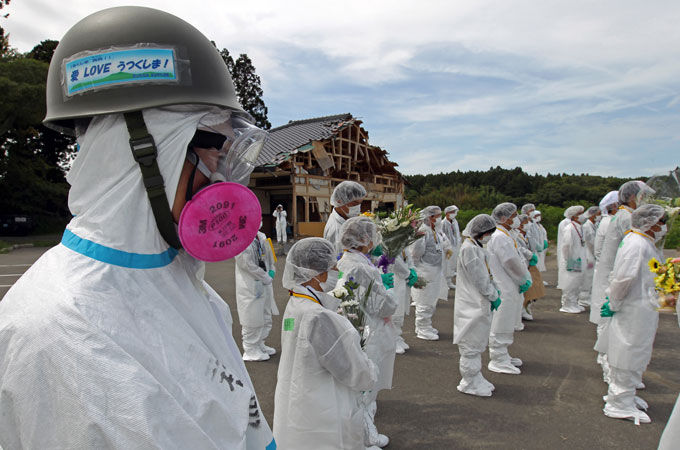
Residents of Ohkuma-cho attend a memorial service for the victims of the March 11 earthquake and tsunami on 24 July 2011 in Ohkuma-cho, Fukushima Prefecture, Japan, 20 km from the Fukushima Daiichi nuclear power plant [EPA]
Scientists and doctors are calling for a new national policy in Japan that mandates the testing of food, soil, water, and the air for radioactivity still being emitted from Fukushima's heavily damaged Daiichi nuclear power plant.
"How much radioactive materials have been released from the plant?" asked Dr Tatsuhiko Kodama, a professor at the Research Centre for Advanced Science and Technology and Director of the University of Tokyo's Radioisotope Centre, in a July 27 speech to the Committee of Health, Labour and Welfare at Japan's House of Representatives.
"The government and TEPCO have not reported the total amount of the released radioactivity yet," said Kodama, who believes things are far worse than even the recent detection of extremely high radiation levels at the plant.
There is widespread concern in Japan about a general lack of government monitoring for radiation, which has caused people to begin their own independent monitoring, which are also finding disturbingly high levels of radiation.
Kodama's centre, using 27 facilities to measure radiation across the country, has been closely monitoring the situation at Fukushima - and their findings are alarming.
According to Dr Kodama, the total amount of radiation released over a period of more than five months from the ongoing Fukushima nuclear disaster is the equivalent to more than 29 "Hiroshima-type atomic bombs" and the amount of uranium released "is equivalent to 20" Hiroshima bombs.
Kodama, along with other scientists, is concerned about the ongoing crisis resulting from the Fukushima situation, as well as what he believes to be inadequate government reaction, and believes the government needs to begin a large-scale response in order to begin decontaminating affected areas.
Distrust of the Japanese government's response to the nuclear disaster is now common among people living in the effected prefectures, and people are concerned about their health.
Recent readings taken at the plant are alarming.
When on August 2nd readings of 10,000 millisieverts (10 sieverts) of radioactivity per hour were detected at the plant, Japan's science ministry said that level of dose is fatal to humans, and is enough radiation to kill a person within one to two weeks after the exposure.
10,000 millisieverts (mSv) is the equivalent of approximately 100,000 chest x-rays.
It is an amount 250 per cent higher than levels recorded at the plant in March after it was heavily damaged by the earthquake and ensuing tsunami.
The operator of Japan's crippled Fukushima Daiichi nuclear power plant, Tokyo Electric Power Company (TEPCO), that took the reading, used equipment to measure radiation from a distance, and was unable to ascertain the exact level because the device's maximum reading is only 10,000 mSv.
TEPCO also detected 1,000 millisieverts (mSv) per hour in debris outside the plant, as well as finding 4,000 mSv per hour inside one of the reactor buildings.
The Fukushima disaster has been rated as a "level seven" on the International Nuclear and Radiological Event Scale (INES). This level, the highest, is the same as the Chernobyl nuclear disaster in 1986, and is defined by the scale as: "[A] major release of radioactive material with widespread health and environmental effects requiring implementation of planned and extended countermeasures."
The Fukushima and Chernobyl disasters are the only nuclear accidents to have been rated level seven on the scale, which is intended to be logarithmic, similar to the scale used to describe the comparative magnitude of earthquakes. Each increasing level represents an accident approximately ten times more severe than the previous level.
Doctors in Japan are already treating patients suffering health effects they attribute to radiation from the ongoing nuclear disaster.
"We have begun to see increased nosebleeds, stubborn cases of diarrhoea, and flu-like symptoms in children," Dr Yuko Yanagisawa, a physician at Funabashi Futawa Hospital in Chiba Prefecture, told Al Jazeera.
She attributes the symptoms to radiation exposure, and added: "We are encountering new situations we cannot explain with the body of knowledge we have relied upon up until now."
"The situation at the Daiichi Nuclear facility in Fukushima has not yet been fully stabilised, and we can't yet see an end in sight," Yanagisawa said. "Because the nuclear material has not yet been encapsulated, radiation continues to stream into the environment."
Health concerns
Al Jazeera's Aela Callan, reporting from Japan's Ibaraki prefecture, said of the recently detected high radiation readings: "It is now looking more likely that this area has been this radioactive since the earthquake and tsunami, but no one realised until now."
Workers at Fukushima are only allowed to be exposed to 250 mSv of ionising radiation per year.
Junichi Matsumoto, a TEPCO spokesman, said the high dose was discovered in an area that does not hamper recovery efforts at the stricken plant.
Yet radioactive cesium exceeding the government limit was detected in processed tea made in Tochigi City, about 160km from the troubled Fukushima Daiichi nuclear plant, according to the Tochigi Prefectural Government, who said radioactive cesium was detected in tea processed from leaves harvested in the city in early July.
The level is more than 3 times the provisional government limit.
Yanagisawa's hospital is located approximately 200km from Fukushima, so the health problems she is seeing that she attributes to radiation exposure causes her to be concerned by what she believes to be a grossly inadequate response from the government.
From her perspective, the only thing the government has done is to, on April 25, raise the acceptable radiation exposure limit for children from 1 mSv/year to 20 mSv/year.
"This has caused controversy, from the medical point of view," Yanagisawa told Al Jazeera. "This is certainly an issue that involves both personal internal exposures as well as low-dose exposures."
Junichi Sato, Greenpeace Japan Executive Director, said: "It is utterly outrageous to raise the exposure levels for children to twenty times the maximum limit for adults."
"The Japanese government cannot simply increase safety limits for the sake of political convenience or to give the impression of normality."
Authoritative current estimates of the health effects of low-dose ionizing radiation are published in the Biological Effects of Ionising Radiation VII (BEIR VII) report from the US National Academy of Sciences.
The report reflects the substantial weight of scientific evidence proving there is no exposure to ionizing radiation that is risk-free.
The BEIR VII estimates that each 1 mSv of radiation is associated with an increased risk of all forms of cancer other than leukemia of about 1-in-10,000; an increased risk of leukemia of about 1-in-100,000; and a 1-in-17,500 increased risk of cancer death.
Dr Helen Caldicott, the founding president of Physicians for Social Responsibility, a group that was awarded the Nobel Peace Prize in 1985, is equally concerned about the health effects from Japan's nuclear disaster.
"Radioactive elements get into the testicles and ovaries, and these cause genetic disease like diabetes, cystic fibrosis, and mental retardation," she told Al Jazeera. "There are 2,600 of these diseases that get into our genes and are passed from generation to generation, forever."
So far, the only cases of acute radiation exposure have involved TEPCO workers at the stricken plant. Lower doses of radiation, particularly for children, are what many in the medical community are most concerned about, according to Dr Yanagisawa.
"Humans are not yet capable of accurately measuring the low dose exposure or internal exposure," she explained, "Arguing 'it is safe because it is not yet scientifically proven [to be unsafe]' would be wrong. That fact is that we are not yet collecting enough information to prove the situations scientifically. If that is the case, we can never say it is safe just by increasing the annual 1mSv level twenty fold."
Her concern is that the new exposure standards by the Japanese government do not take into account differences between adults and children, since children's sensitivity to radiation exposure is several times higher than that of adults.
Al Jazeera contacted Prime Minister Naoto Kan's office for comment on the situation.
Speaking on behalf of the Deputy Cabinet Secretary for Public Relations for the Prime Minister's office, Noriyuki Shikata said that the Japanese government "refers to the ICRP [International Commission on Radiological Protection] recommendation in 2007, which says the reference levels of radiological protection in emergency exposure situations is 20-100 mSv per year. The Government of Japan has set planned evacuation zones and specific spots recommended for evacuation where the radiation levels reach 20 mSv/year, in order to avoid excessive radiation exposure."
The prime minister's office explained that approximately 23bn yen ($300mn) is planned for decontamination efforts, and the government plans to have a decontamination policy "by around the end of August", with a secondary budget of about 97bn yen ($1.26bn) for health management and monitoring operations in the affected areas.
When questioned about the issue of "acute radiation exposure", Shikata pointed to the Japanese government having received a report from TEPCO about six of their workers having been exposed to more than 250 mSv, but did not mention any reports of civilian exposures.
Prime Minister Kan's office told Al Jazeera that, for their ongoing response to the Fukushima crisis, "the government of Japan has conducted all the possible countermeasures such as introduction of automatic dose management by ID codes for all workers and 24 hour allocation of doctors. The government of Japan will continue to tackle the issue of further improving the health management including medium and long term measures".
Shikata did not comment about Kodama's findings.
Kodama, who is also a doctor of internal medicine, has been working on decontamination of radioactive materials at radiation facilities in hospitals of the University of Tokyo for the past several decades.
"We had rain in Tokyo on March 21 and radiation increased to .2 micosieverts/hour and, since then, the level has been continuously high," said Kodama, who added that his reporting of radiation findings to the government has not been met an adequate reaction. "At that time, the chief cabinet secretary, Mr Edano, told the Japanese people that there would be no immediate harm to their health."
Kodama is an expert in internal exposure to radiation, and is concerned that the government has not implemented a strong response geared towards measuring radioactivity in food.
"Although three months have passed since the accident already, why have even such simple things have not been done yet?" he said. "I get very angry and fly into a rage."
According to Kodama, the major problem caused by internal radiation exposure is the generation of cancer cells as the radiation causes unnatural cellular mutation.
"Radiation has a high risk to embryos in pregnant women, juveniles, and highly proliferative cells of people of growing ages. Even for adults, highly proliferative cells, such as hairs, blood, and intestinal epithelium cells, are sensitive to radiation."
'Children are at greater risk'
Early on in the disaster, Dr Makoto Kondo of the department of radiology of Keio University's School of Medicine warned of "a large difference in radiation effects on adults compared to children".
Kondo explained the chances of children developing cancer from radiation exposure was many times higher than adults.
"Children's bodies are underdeveloped and easily affected by radiation, which could cause cancer or slow body development. It can also affect their brain development," he said.
Yanagisawa assumes that the Japanese government's evacuation standards, as well as their raising the permissible exposure limit to 20mSv "can cause hazards to children's health," and therefore "children are at a greater risk".
Nishio Masamichi, director of Japan's Hakkaido Cancer Centre and a radiation treatment specialist, published an article on July 27 titled: "The Problem of Radiation Exposure Countermeasures for the Fukushima Nuclear Accident: Concerns for the Present Situation".
In the report, Masamichi said that such a dramatic increase in permitted radiation exposure was akin to "taking the lives of the people lightly". He believes that 20mSv is too high, especially for children who are far more susceptible to radiation.
"No level of radiation is acceptable, for children or anyone else," Caldicott told Al Jazeera. "Children are ten to 20 times more sensitive than adults. They must not be exposed to radiation of any level. At all."
In early July, officials with the Japanese Nuclear Safety Commission announced that approximately 45 per cent of children in the Fukushima region had experienced thyroid exposure to radiation, according to a survey carried out in late March. The commission has not carried out any surveys since then.
"Now the Japanese government is underestimating the effects of low dosage and/or internal exposures and not raising the evacuation level even to the same level adopted in Chernobyl," Yanagisawa said. "People's lives are at stake, especially the lives of children, and it is obvious that the government is not placing top priority on the people's lives in their measures."
Caldicott feels the lack of a stronger response to safeguard the health of people in areas where radiation is found is "reprehensible".
"Millions of people need to be evacuated from those high radiation zones, especially the children."
Dr Yanagisawa is concerned about what she calls "late onset disorders" from radiation exposure resulting from the Fukushima disaster, as well as increasing cases of infertility and miscarriages.
"Incidence of cancer will undoubtedly increase," she said. "In the case of children, thyroid cancer and leukemia can start to appear after several years. In the case of adults, the incidence of various types of cancer will increase over the course of several decades."
Yanagisawa said it is "without doubt" that cancer rates among the Fukushima nuclear workers will increase, as will cases of lethargy, atherosclerosis, and other chronic diseases among the general population in the effected areas.
Yanagisawa believes it is time to listen to survivors of the atomic bombings. "To be exposed to radiation, to be told there is no immediate effect, and afterwards to be stricken with cancer - what it is like to suffer this way over a long period of time, only the survivors of the atomic bombings can truly understand," she told Al Jazeera.
Radioactive food and water
An August 1 press release from Japan's MHLW said no radioactive materials have been detected in the tap water of Fukushima prefecture, according to a survey conducted by the Japanese government's Nuclear Emergency Response Headquarters.
The government defines no detection as "no results exceeding the 'Index values for infants (radioactive iodine)'," and says "in case the level of radioactive iodine in tap water exceeds 100 Bq/kg, to refrain from giving infants formula milk dissolved by tap water, having them intake tap water ... "
Yet, on June 27, results were published from a study that found 15 residents of Fukushima prefecture had tested positive for radiation in their urine.
Dr Nanao Kamada, professor emeritus of radiation biology at Hiroshima University, has been to Fukushima prefecture twice in order to take internal radiation exposure readings and facilitated the study.
"The risk of internal radiation is more dangerous than external radiation," Dr Kamada told Al Jazeera. "And internal radiation exposure does exist for Fukushima residents."
According to the MHLW, distribution of several food products in Fukushima Prefecture remain restricted. This includes raw milk, vegetables including spinach, kakina, and all other leafy vegetables, including cabbage, shiitake mushrooms, bamboo shoots, and beef.
The distribution of tealeaves remains restricted in several prefectures, including all of Ibaraki, and parts of Tochigi, Gunma, Chiba, Kanagawa Prefectures.
Iwate prefecture suspended all beef exports because of caesium contamination on August 1, making it the fourth prefecture to do so.
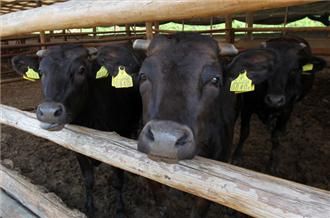
Due to caesium contaminated straw, beef exports have been banned in four Japanese prefectures [EPA]
Jyunichi Tokuyama, an expert with the Iwate Prefecture Agricultural and Fisheries Department, told Al Jazeera he did not know how to deal with the crisis. He was surprised because he did not expect radioactive hot spots in his prefecture, 300km from the Fukushima nuclear plant.
"The biggest cause of this contamination is the rice straw being fed to the cows, which was highly radioactive," Tokuyama told Al Jazeera.
Kamada feels the Japanese government is acting too slowly in response to the Fukushima disaster, and that the government needs to check radiation exposure levels "in each town and village" in Fukushima prefecture.
"They have to make a general map of radiation doses," he said. "Then they have to be concerned about human health levels, and radiation exposures to humans. They have to make the exposure dose map of Fukushima prefecture. Fukushima is not enough. Probably there are hot spots outside of Fukushima. So they also need to check ground exposure levels."
Caldicott said people around the world should be concerned about the ongoing nuclear crisis at the Fukushima Daiichi plant. Radiation that continues to be released has global consequences.
More than 11,000 tonnes of radioactive water has been released into the ocean from the stricken plant.
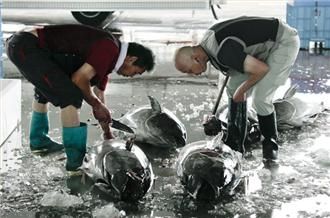
Scientists warn that tuna caught off the Pacific coastal prefecture in northern Japan are now at risk of being radioactive [EPA]
"Those radioactive elements bio-concentrate in the algae, then the crustaceans eat that, which are eaten by small then big fish," Caldicott said. "That's why big fish have high concentrations of radioactivity and humans are at the top of the food chain, so we get the most radiation, ultimately."
On August 6, the 66th anniversary of the US nuclear bombing of Hiroshima, Japanese Prime Minister Naoto Kan said: "Regarding nuclear energy, we will deeply reflect over the myth that nuclear energy is safe. We will thoroughly look into the cause of the [Fukushima] accident, and to secure safety, we'll implement fundamental measures while also decreasing the degree of dependence on nuclear power generation, to aim for a society that does not rely on nuclear power."
But doctors, scientists, agricultural experts, and much of the general public in Japan feel that a much more aggressive response to the nuclear disaster is needed.
Kodama believes the government needs to begin a large-scale response in order to begin decontaminating affected areas. He cited Japan's itai itai disease, when cadmium poisoning from mining resulted in the government eventually having to spend 800 billion yen to decontaminate an area of 1,500 hectares.
"How much cost will be needed if the area is 1,000 times larger?"
05 August 2011
Japan’s Fukushima catastrophe brings big radiation spikes to B.C.

Gordon Edwards, president of the Canadian Coalition for Nuclear Responsibility, says that while radiation coming from Fukushima will lead to higher cancer rates among Canadians, the risk posed to individuals is very small.
By Alex Roslin, August 4, 2011
Nuclear impact
After Japan’s Fukushima catastrophe, Canadian government officials reassured jittery Canadians that the radioactive plume billowing from the destroyed nuclear reactors posed zero health risks in this country.
In fact, there was reason to worry. Health Canada detected massive amounts of radioactive material from Fukushima in Canadian air in March and April at monitoring stations across the country.
The level of radioactive iodine spiked above the federal maximum allowed limit in the air at four of the five sites where Health Canada monitors levels of specific radioisotopes.
On March 18, seven days after an earthquake and tsunami triggered eventual nuclear meltdowns at the Fukushima Daiichi plant in Japan, the first radioactive material wafted over the Victoria suburb of Sidney on Vancouver Island.
For 22 days, a Health Canada monitoring station in Sidney detected iodine-131 levels in the air that were 61 percent above the government’s allowable limit. In Resolute Bay, Nunavut, the levels were 3.5 times the limit.
Meanwhile, government officials claimed there was nothing to worry about. “The quantities of radioactive materials reaching Canada as a result of the Japanese nuclear incident are very small and do not pose any health risk to Canadians,” Health Canada says on its website. “The very slight increases in radiation across the country have been smaller than the normal day-to-day fluctuations from background radiation.”
In fact, Health Canada’s own data shows this isn’t true. The iodine-131 level in the air in Sidney peaked at 3.6 millibecquerels per cubic metre on March 20. That’s more than 300 times higher than the background level, which is 0.01 or fewer millibecquerels per cubic metre.
“There have been massive radiation spikes in Canada because of Fukushima,” said Gordon Edwards, president of the Canadian Coalition for Nuclear Responsibility.
“The authorities don’t want people to have an understanding of this. The government of Canada tends to pooh-pooh the dangers of nuclear power because it is a promoter of nuclear energy and uranium sales.”
Edwards has advised the federal auditor-general’s office and the Ontario government on nuclear-power issues and is a math professor at Montreal’s Vanier College.
In a phone interview from his Montreal home, he said radiation from Fukushima will lead to higher rates of cancer and other diseases among Canadians. But don’t panic. Edwards cautioned that the risk is very small for any particular individual.
“It’s not the risk to an individual that’s the problem but how much society is at risk. When you are exposing millions of people to an insult, even if the average dose is quite small, we are going to see fatal health effects,” he said.
Some impacts may have already occurred in North America. Infant mortality in eight cities in the U.S. Northwest jumped 35 percent after Fukushima, according to an article by internist and toxicologist Janette Sherman and epidemiologist Joseph Mangano on the Counterpunch website in June. The number of infant deaths rose from 9.25 per week in the four weeks prior to March 19 to 12.5 per week in the following 10 weeks, according to U.S. Centers for Disease Control data.
“There has been a dismissiveness about the long-term hazards of nuclear power,” said Dr. Curren Warf, adolescent-medicine division head at B.C. Children’s Hospital.
Warf was on the board of the Nobel Peace Prize–winning U.S. antinuclear group Physicians for Social Responsibility before he moved to B.C. in 2009.
“These were some of the most advanced nuclear power plants in the world. But a natural earthquake and tsunami rendered their safety measures completely meaningless,” he said in a phone interview while on vacation in Tofino on Vancouver Island.
It’s not clear what health impacts British Columbians will face from the fallout from Fukushima, Warf said. But he added, “It should be a warning to Canada, the U.S., and the rest of the world about the vulnerability of nuclear power plants to natural catastrophes. These things have typically been dismissed in much of the planning.”
Dr. Erica Frank agrees. “The main concern I’ve had is we are not paying attention to Fukushima as a warning sign. Given the catastrophic long-term issues and what to do about nuclear waste, I had hoped it would be more of a wake-up [call] than it was,” said Frank, a professor of population and public health in UBC’s faculty of medicine and a past president of Physicians for Social Responsibility.
She called on Canada to follow Germany’s lead, which, in response to Fukushima, decided in May to phase out all of its nuclear power plants by 2022. “If Germany can do it, we can too,” she said in a phone interview from her Vancouver home.
With 450,000 people homeless, fallout across much of Japan, and a damages bill estimated at $300 billion, Fukushima is the “biggest industrial catastrophe in the history of mankind”, said U.S. nuclear-industry whistle blower Arnold Gundersen in a June 10 Al Jazeera story.
Even the Tokyo Electric Power Company, which owns the Fukushima plant, has acknowledged that the disaster may surpass the 1986 Chernobyl catastrophe. “The radiation leak has not stopped completely, and our concern is that the amount of leakage could eventually reach that of Chernobyl or exceed it,” a TEPCO official said in an April media release.
In the case of Chernobyl, radiation caused 985,000 deaths worldwide—including almost 170,000 in North America—between 1986 and 2004, according to a Russian study published by the New York Academy of Sciences in 2009. Fallout contaminated about 100,000 square kilometres of land. And 25 years later, five to seven percent of government spending in Ukraine is still devoted to dealing with the disaster’s health, environmental, and other after-effects.
The impacts of Fukushima are still in the earliest stages of being determined, especially since the nuclear plant is still spewing huge amounts of radiation. On Monday, TEPCO reported detecting record-high radiation levels at the plant—double the previous record set in early June. The new level—at least 10 sieverts (10,000 millisieverts) per hour—could cause death or incapacitation within a few seconds’ exposure.
Japan’s prime minister, Naoto Kan, said in July that decommissioning the plant would take “several decades”.
Fallout has contaminated food and water across Japan. In July, officials reported that Japanese consumers had eaten meat contaminated with radioactive material. Cattle feed at one farm had levels of radioactive cesium 57 times higher than the government ceiling.
Japanese investigators later determined that almost 3,000 cattle had eaten radioactive feed before being shipped to market. Prices of Japanese beef collapsed after 23 out of 274 beef samples exceeded government radiation limits.
In Tokyo, radioactive iodine in tap water reached double the government ceiling in March. Meanwhile, TEPCO reported in April that a seawater sample near the Fukushima plant contained 7.5 million times what was described as the legal amount of iodine-131.
TEPCO released 11,500 tons of radioactive water from its storage tanks into the Pacific Ocean on April 4.
One aspect of the fallout and seawater contamination that remains unclear is how it might affect fish stocks, especially migratory species like salmon that could pass through poisoned areas of the ocean, eat irradiated prey, or have radioactive water dumped in their home ranges by Pacific currents.
Of the five species of Pacific salmon that are native to western North America, the sockeye is the most commercially prized. It also has the most wide-ranging migration route through the North Pacific, swimming for two to three years—as far as just northeast of the top of Japan—before coming back to its natal streams in Alaska, B.C., and the U.S. Northwest.
This year’s returning sockeye are just starting to be caught off Vancouver Island’s west coast. So far, there is no word as to whether or not these fish will be tested. According to an April 17 story in the Anchorage Daily News, U.S. federal officials have already stated that there is no need to even test Alaskan salmon.
Across the Pacific Ocean, it took only a few days after the disaster for radioactive fallout to start showing up in drinking water and milk across North America. Governments in both Canada and the U.S. monitored the radioactivity, but their data is reported in such a confusing and irregular way that it’s extremely difficult to determine if maximum contamination levels have been exceeded and how public health is being impacted.
“It’s very, very difficult to interpret radiation levels detected from Fukushima and translate them into standards. It’s a nightmare,” said Arjun Makhijani, an electrical and nuclear engineer and president of the Takoma Park, Maryland–based Institute for Energy and Environmental Research, in a phone interview.
And that’s not a coincidence, said Vanier College’s Gordon Edwards. “To me, it’s a way of obscuring the impacts. It’s a smoke screen.”
Dale Dewar agrees. “The government always downgrades the results. They want to soft-pedal the extent of the accident because it will threaten our own nuclear industry,” said Dewar, a family physician and the executive director of Canadian antinuclear group Physicians for Global Survival, in a phone interview from her home near Wynyard, Saskatchewan.
One of the highest post-Fukushima radiation readings in North America came on March 27 in rainwater in Boise, Idaho. It contained 14.4 becquerels of iodine-131 per litre—130 times the U.S. Environmental Protection Agency’s maximum contamination level of 0.11 millibecquerels per litre.
EPA officials said in media reports that the high levels didn’t pose a health threat. For the agency to sound an alarm, it says, a person would have to exceed its maximum level for an entire year, drinking two litres of the contaminated water each day.
But nobody seemed to investigate how long the rainwater in Boise remained radioactive. Inexplicably, the EPA stopped monitoring Boise’s rainwater after the extremely high reading on March 27. The agency’s only other reading for the city was on March 22.
That day, the iodine-131 level hit nine becquerels per litre.
In fact, if the two readings are averaged out and stayed just as elevated over the entire six-day period from March 22 to 27, a person drinking the Boise rainwater during this time would have exceeded the EPA’s annual ceiling by 75 percent.
In B.C.’s Lower Mainland, iodine-131 in the rainwater hit almost the same level as in Boise. It also seems to have exceeded the EPA’s ceiling.
On March 19, the iodine-131 level in rainwater in Burnaby suddenly spiked from zero to nine becquerels per litre. The next day, it rose even further, to 13, according to data collected and released by Krzysztof Starosta, an associate professor of chemistry at SFU, and others.
The iodine-131 levels remained well above the background level (which is close to zero) for 12 days.
The average level of radioactive iodine was seven becquerels per litre over the 12 days. That means a person drinking two litres of the rainwater per day would have consumed 166 becquerels of iodine-131 during that period.
That’s more than double the maximum amount that the EPA says a person can drink in an entire year, which is 81 becquerels.
Starosta did not respond to phone and email messages seeking comment.
Starosta issued a statement on March 28 saying the levels were safe because they were lower than levels detected after the Chernobyl disaster.
“As of now, the levels we’re seeing are not harmful to humans. We’re basing this on Japanese studies following the Chernobyl incident in 1986 where levels of iodine-131 were four times higher than what we’ve detected in our rainwater so far,” the statement said.
The contaminated rainwater also didn’t spark concern from Canadian public-health officials. That’s in large part because Canadian standards are far more lenient on radioactive contamination than those of the EPA.
Canada allows six becquerels per litre of iodine-131 in drinking water—or 54 times more than the EPA. By the much higher Canadian ceiling, the rainwater in Burnaby was fine to drink.
At the B.C. Ministry of Health Services, spokeswoman Laura Neufeld referred questions about radiation monitoring to Health Canada. A Health Canada spokesperson, Stéphane Shank, didn’t return the Straight’s call. (Shank is the same Health Canada employee who did not return calls regarding a recent Straight story on nanoparticles.)
“It shows you these standards are not scientifically based,” Edwards said. “They’re arbitrary and really based on political considerations. We have a government strongly committed to the export of uranium and promotion of nuclear energy.”
And even if the radiation level in Burnaby didn’t hit the far higher Canadian ceiling, Edwards said, any amount of radiation can cause cancer and other illness. “To suggest that a certain level of radiation exposure is safe is untrue. It verges on misrepresentation. There is no evidence that there is any safe level of radiation exposure. It means you should operate as far below that level as you can,” he said.
Either way, without adequate monitoring, we may never know the impacts on Canadians.
From comments:
Ionizing radiation can break molecules, at a cellular level, causing unpredictable chemical reactions.Think of vibrations breaking glass, that is what happens at a cellular level, in your body, from ionizing radiation.
Ionizing radiation is insidious, these large subatomic particles travel until they are stopped.
Your skin can easily stop them.
Once they are ingested, inhaled, or enter your body through a cut, their grotesque potent force cuts through your body like knife through butter, into the cells, blood or other organs, impacting other organs and leaving behind hideous, shocking damage.
A single alpha particle from Plutonium, Uranium, Americium or Radon can deliver a huge blast of radiation inside your body. This radiation energy can destroy your genetic material at a cellular level.
Once radionuclides are released into the environment they circulate and are carried with the winds until they become part of the soil and food chain. They land in our drinking water, are on the pastures that our livestock graze on, are on our vegetables and in our fruit trees.
This is particularly dangerous for humans because we are at the top of the food chain, where the higher concentrations of radionuclides are.
Most Common Diseases From Ionizing Radiation:
* leukemia
* lymphoma
* solid tumors or any organ
* bone & blood disorders
* lung cancer
* breast cancer
* endocrine disruption
* reproductive abnormalities
* accelerated aging process
* birth defects
* congenital malformations
* kidney, liver damage
These diseases and mutations don't stop with us. If ionizing radiation enters our genes, not only does it cause irreversible damage to this generation, but to future generations, as evidenced by children being born years after Chernobyl.
In Washington state, we've been detoxing and taking other precautions for ourselves, our animals and our soils since March 14.
Because of the 31 radioactive elements spewing for almost 5 months, these precautions will continue for the rest of our lives.
Are you waiting for government permission to protect yourself?
Another comment:
a few things to note.
1/ To Douglas Gray, the Hanford I know about is in south central Washington State and is the site of a huge nuclear waste and processing facility. It presents a danger to everyone in the area including southern BC. EPA radiation monitoring after Fukishima began at Richland Wa. next to Hanford on March 3 and ended March 31 after the levels went from 81 CPM(counts-per-minute) on the 30th to 277 CPM on the 31st.
2/ Health Canada operates(ed?) The Canadian Radiological Monitoring Network (CRMN) managed by the Radiation Surveillance and Health Assessment Division, Radiation Protection Bureau (RPB). Their online Monitoring Data stopped being posted for the only mainland BC station (Vancouver) three years ago or more.
3/ There is no safe level of radiation exposure. If the normal background is increased by 20% that will likely cause 20% more radiation induced cancers in the population exposed. The idea of safe limits comes from the kind of thinking that brought us pesticide regulation. Pesticides are tested for toxicity on a given animal and the mortality is expressed as an LD50 number. This disregards the long term effects, mutagenic and more subtle nervous system damage. So with radiation dose they look at deaths from radiation poisoning: an extreme effect caused by massive exposure. Ionizing radiation can cause cell damage at any level, it just becomes more likely the higher the exposure.
I have been monitoring background radiation in the BC interior since Fukishima (with a couple of breaks) and you can see my data at http://lumbywatch.ca
Subscribe to:
Posts (Atom)


